How Did Rudolf Steiner Die? The Hard Facts
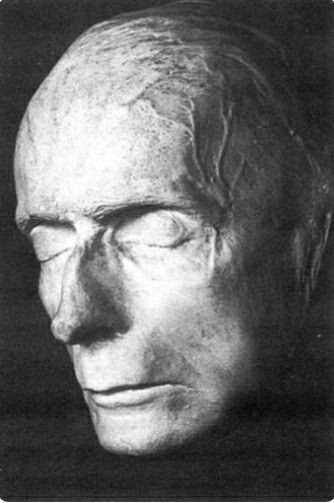
The question “How did Rudolf Steiner die” still occupies many people and has led to a lot of speculation for a hundred years. In short, I cannot give you a final answer but I will describe the cold facts as best as I can, to try and give you a solid foundation for your own judgment. (The image shows Rudolf Steiner's death mask.)
What is certain, is that Rudolf Steiner (born 1861) became severely ill in September 1924 and was largely bound to bed until his death at age 64 on March 30th, 1925. During this time he received treatment and care from Dutch medical doctor Ita Wegman, who was a close associate of his (they developed anthroposophical medicine and wrote a fundamental book about this together – the only book Steiner co-authored with another person).
However, a real diagnosis for his illness was never established and no autopsy was performed on his body. Some medical professionals have speculated about him having some illness of the stomach, perhaps stomach cancer, but this remains speculation.
Did Rudolf Steiner Work Himself to Death?
One answer often given to the question how did Rudolf Steiner die, is the fact that he worked extremely hard, actually ever harder as his life progressed, until the point of exhaustion and death.
And indeed, Steiner was convinced that modern society would descend chaos, wars and mental health suffering if people did not embrace a true spiritual renewal of themselves and society, and he was determined to give this his all. But while this may explain his weakening of powers, it does not automatically explain his 6-month illness resulting in a rather early death.
Was Rudolf Steiner Poisoned?
The scene happened on January 1st, 1924. Ilona Schubert, who was present there, describes how Steiner, during a social gathering as a close of the Christmas Conference, had a piece of cake and then became very unwell, retreated in a room backstage and collapsed. According to Schubert, he uttered something about being poisoned. Others wanted to fetch a doctor, but Steiner told them not to, drank liquids to flush his body, and when he got better, forbade everyone present to speak about the incident. About 9 months later his illness began.
The fact that the incident was described by others in ever different versions – and always decades later – makes it difficult to establish what really had happened. It is possible that Steiner’s words about being poisoned were misunderstood and it was “just” some food intolerance – or that Steiner in the heat of the moment jumped to conclusions. It is certain, however, that Steiner later publicly never said anything again about having been poisoned. On the contrary, he criticized the fact that so many rumors had spread about the nature of his illness. Also, during the Christmas Conference, including the social gathering on January 1st, only anthroposophists were allowed in, so Steiner would then have been poisoned by one of this friends or associates. This seems highly unlikely.
On the other hand, it’s a fact that anthroposophist Ehrenfried Pfeiffer, who spent considerable time in the United States, describes having met a man there who said he was ordered to poison Steiner. The poison was not meant to kill Steiner but to eliminate his occult powers and abilities and deter him, so that enemies of Steiner could point to him and warn others that this is what happens if you try to do occult research yourself.
Pfeiffer describes this event briefly in the afterword of his autobiographical book Ein Leben für die Geist. While I don’t doubt that Pfeiffer really met this man – Pfeiffer had an impeccable reputation and was a direct and fruitful student and coworker of Rudolf Steiner – nothing else is known about this man and nobody apparently has investigated the story. By itself, such a ‘confession’ may not mean too much. Why would somebody who had actually committed such a crime, confess this without pressure to an opponent?
In any case, if the aim was to take away Rudolf Steiner’s occult research abilities and this was done on January 1st, 1924, then the attempt was clearly unsuccessful as Steiner published hugely important works based on original and recent occult research (e.g. his karma lectures) during 1924 and the killer(s) have also not succeeded in making a negative example of Steiner in the public eye.
Did Steiner Suffer from the Inertness of his Followers?
Another possibility seems to me personally – for what it’s worth – more likely. In June 1924, Rudolf Steiner apparently told Johanna von Keyserlingk that the impulse of the Christmas Conference was not taken up enough by the anthroposophists, that there was still time until Michaeli 1924 (this feast day is on September 29th) but if it didn’t happen by then, demons would strike. She told another close associate of Steiner, Rudolf Meyer, who immediately wrote this down and reported this to others. Fact is, on September 28th did Steiner give his last lecture which he couldn’t complete as he was too ill.
This point of view has large consequences and should not be accepted too easily. But author and lifelong Steiner student Emanuel Zeylmans van Emmichoven has found documentary evidence to support this. When researching the cooperation between Ita Wegman and Rudolf Steiner in a Dornach archive, he found a forgotten suitcase which contained an original handwritten note and drawing from Steiner showing a demon with the text: “We – the anti-Michael-demons – will arrive at the four, when you do not succeed to do the necessary before the Michael-Pentecost-battle.” (“Arriving at the four”, Zeylmans van Emmichoven adds, is occult language for the fact that these demons are not free beings and interfere in our human world with a kind of iron determinism.)
It is a fact that Steiner often spoke critical, with sadness and even bitterness, about what he saw as the shortcomings and inertness of his followers, and after Steiner’s death the Anthroposophical Society was torn by conflicts among his closest associates.
So How Did Rudolf Steiner Die?
My conclusion: the question "How did Rudolf Steiner die" cannot be definately answered unless new facts emerge. But in this article I described the main views on Steiner’s death that circulate among his followers with a summary of what speaks for and against these views.