Who Was Rudolf Steiner?

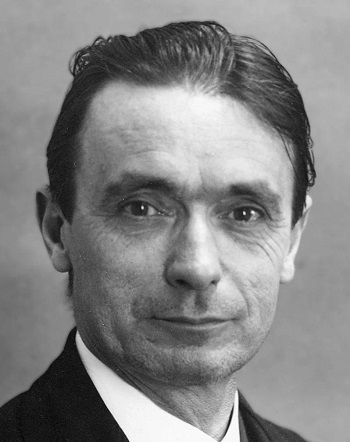
Rudolf Steiner (1861-1925) was an Austrian clairvoyant, philosopher, writer, architect, artist and social reformer with a unique view on human nature, society and pedagogy. The question “Who was Rudolf Steiner” can perhaps best be answered in one phrase with: He was the last true Renaissance Man whose activities and creations encompass almost every aspect of human life, comparable to Leonardo da Vinci.
Steiner became known as the founder of anthroposophy and its practical applications, such as Waldorf education, anthroposophical medicine, curative pedagogy for the mentally and physicaly challenged, social threefolding, biodynamic agriculture and organic architecture. He also provided assistance and advice in the founding of the Christian Community religious community.
Clairvoyant as a Boy
Rudolf Steiner was born in 1861 in Kraljevec in the Austrian Empire, the first of three children. As a boy, he already had clairvoyant experiences. In his (incomplete) autobiography The Story of My Life he describes how he, at age 7, witnessed an astral appearance of his aunt who asked his help, and whom – he and his parents learned only much later – had died shortly before through suicide.
When he told his mother, she only said “You are a dumb boy”. Through such experiences, he learned that there is a world ‘that people see’ and a world ‘that people don’t see’ – and he learned to remain silent about the latter because of the misappreciation of adults.
Broad Interests
Even in elementary school, he acquired knowledge independently using textbooks. He had huge and broad interests, including an interest in technology. His father worked as a railroad official and telegraph operator for the Austrian Railways in various villages in the Austrian Empire, allowing the young Rudolf to experience these – then brand new – technologies of railroads and telegraph directly.
Education and Promotion

At the age of 16, he began to study Kant's writings extensively. At age 21 he met a man with occult abilities and an unusual autodidact knowledge of plants and herbs who introduced him to many secrets of nature. Later this man – Felix Koguzki – introduced him to an even more important teacher who Steiner only once referred to in a private autobiographical sketch.
After secondary school, Steiner studied mathematics, natural sciences, chemistry and biology at the Vienna University of Technology, with the goal of becoming a teacher. He also attended lectures in philosophy, literature, and history, and ultimately earned his doctorate (PhD) from the University of Rostock with a dissertation on the fundamental questions of epistemology, or “theory of knowledge”, in which he shows that the realm of the spirit is not closed to human thought.
From 1882 to 1897, he edited Johann Wolfgang von Goethe's scientific writings. Alongside his teaching position at the Workers' Education School in Berlin, he was also the editor of the "Magazine for Literature" there. His first well-known work, "The Philosophy of Spiritual Activity", was published in 1894.

All this time, although he was increasingly clairvoyant and was an anti-materialist and spiritual person, Steiner wasn’t a Christian. In the 1890s he became a avid (though critical) reader of Friedrich Nietzsche en later an admirer of Max Stirner, who even went further in his rejection of social ethics and obliged altruism.
In the later part of the 1890s this deteriorated in a “crisis of the soul” as Steiner would later call it, ending with Steiner having a profound spiritual experience in which he clairvoyantly, and apparently for days on end, saw in the spiritual worlds the hugely important event of the death and resurrection of Christ at Golgotha – an event which he, in his autobiography and there alone, only once mentioned in one brief and poignant sentence. Only then was he thoroughly convinced of the huge importance of Christianity.
Public Outing as a Clairvoyant
Until then had Steiner only spoken about regular non-esoteric subjects, describing his views in philosophical terms without any mention of higher spiritual realities. Only in 1900 Steiner delivered his first esoteric lecture for a Theosophical gathering, and decided to join the Theosophical Society not because he agreed on everything but because he viewed it as an occult law that an occultist always has to connect to existing streams and organisations before launching one’s own. He viewed the Theosophical Society as the only organization with a spiritual life that could be taken seriously. He knew that the question "Who was Rudolf Steiner" would now forever be answered differently once he spoke out as a clairvoyant.
In 1902 he was asked to become Secretary General of the German section of the Theosophical Society, which he did while obtaining the right to promote his own views as he saw fit. Over the years things deteriorated within the TS and a conflict over the promotion of Jiddu Krishnamurti as the reincarnated Christ – a view that Steiner thought was absurd – led to the ousting of Steiner by the Theosophists, after which Steiner founded the Anthroposophical Society in 1923 with most of the German Theosophists following him.
From 1900 on Steiner began to give lectures in many European countries, gave courses and published books and articles. Between 1904 and 1910, he published – among others – 3 books which would become cornerstones of his ‘anthroposophy’: Theosophy (1904), How to Know Higher Worlds (1904) and Occult Science: an Outline (1910) (more about them here). In this, anthroposophy is brought as a spiritual science rooted in Western philosophy, Christianity and the European occult tradition such as the Rosicrucians.
All in all Steiner wrote about 40 books himself, but as he also held about 6,000 lectures during his lifetime – all of them unique – which have also been published in book form, his collected works in German number some 400 volumes. This allegedly makes it the biggest collected works by a single author in het history of non-fiction book publishing. Of these, over 100 volumes have been translated into English.
Practical Applications
Especially after the First World War (ending in 1918), Steiner developed ever more practical applications of anthroposophy. The most well-known of these, no doubt, is Waldorf education. In 1919, factory owner Emil Molt asked Rudolf Steiner to found a school for the children of his co-workers, after which the first Waldorf School was founded. Waldorf education stresses for example the importance to approach each pupil as an individuality with his own identity and ‘mission’ in life, and to give equal time to ‘head’ (English, math), ‘heart’ (music, theater, drawing) and ‘hands’ (e.g. learning how to knit, carve wood or forge metal). Nowadays, Waldorf education is the largest alternative educational movement worldwide with over 1,000 schools on all continents.
Another hugely influential application is biodynamical agriculture, for which Steiner’s 1924 lectures laid the foundation. In biodynamic farming, a farm is seen as a small independent ecosystem by itself so that e.g. animals are fed by the harvest of its own land and the animals’ manure are used as fertilizer on the same land. The manure is specifically prepared by esoteric methods and the positions of the planets are taken into account when sowing and harvesting. Animals are treated with integrity so that e.g. cows can keep their horns. It can be safely said that ‘regular’ organic farming is a derivative of Steiner’s original approach.
The practical applications actually are too many to describe in full in these short biographical sketch. In architecture, for example, Steiner was a pioneering figure. He designed the first Goetheanum building which was made from wood and destroyed by fire during New Year's Night 1922/1923, then the current Goethanum building which is entirely made of concrete (then brand new) and today functions as the movement’s headquarters. Through anthroposophical medicine, he developed methods and medications that reckon with how the human body, soul and spirit interact in health and sickness. Through curative education, he developed methods to offer development and progress for the mentally and physically challenged. He also inspired new forms of movement and dance (eurythmy) and social therapy. Steiner’s ideas have even been applied to banking. The multinational Triodos Bank has received awards for being the world’s most sustainable bank.
So Who Was
Rudolf Steiner?
Today, Rudolf Steiner remains a complex and polarizing figure. Admirers view him as a visionary who sought to heal the fragmentation of modern life by reconnecting science, art, and spirituality. Critics question Steiner’s clairvoyant abilities or even accuse him of racism. Regardless of perspective, Steiner’s impact on education, agriculture, and cultural life is large and still growing, more than a century after his death.
British author Owen Barfield, who was one of the Inklings (a literary group that included C. S. Lewis and J. R. R. Tolkien) answered the question "Who was Rudolf Steiner" this way: he was “the twentieth century’s best kept secret”.